Trump Arrives in Beijing for High-Stakes Summit as China Draws “Four Red Lines” is the kind of headline that instantly grabs attention, because this is not just another diplomatic visit. It is a moment loaded with trade pressure, security concerns, and global market nerves. If you are trying to understand what really changed, why Beijing is drawing hard boundaries, and how this summit could affect the US-China relationship, you are in the right place. Sach bolo toh, this is the kind of news that can move headlines, markets, and geopolitics all at once. In this update, we break down what happened, what China’s “four red lines” mean, the possible agenda, and why the world is watching every move closely. Trump Arrives in Beijing for High-Stakes Summit as China Draws “Four Red Lines” is already being searched widely, and the next few hours could decide how tense or productive this meeting becomes.
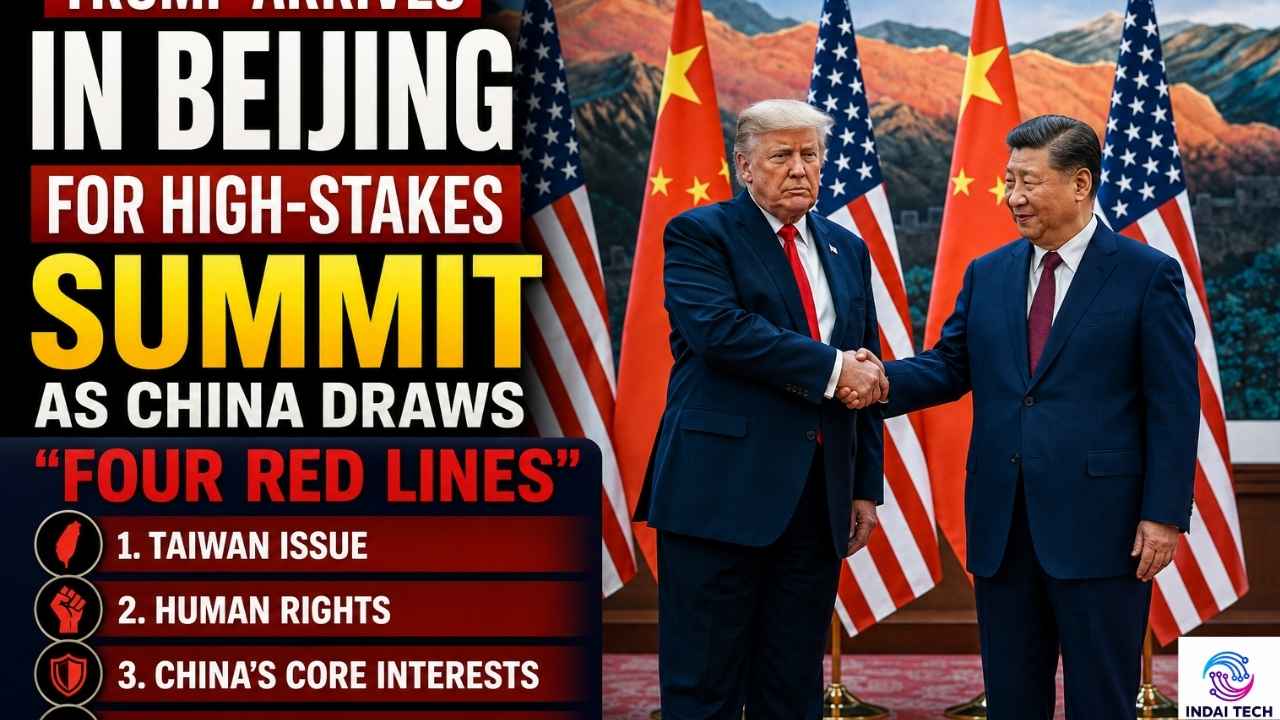
Table of Contents
What happened as Trump Arrives in Beijing for High-Stakes Summit as China Draws “Four Red Lines”?
The latest buzz around Trump Arrives in Beijing for High-Stakes Summit as China Draws “Four Red Lines” centers on a very sensitive diplomatic moment. Trump’s arrival in Beijing has put the spotlight back on US-China ties at a time when both sides are under pressure over trade, technology restrictions, security flashpoints, and military posturing.
China’s message is unusually firm. Reports around the summit suggest Beijing is signaling that it will not compromise on certain core issues. That is where the phrase “four red lines” comes in. In simple terms, these are the areas China wants Washington to avoid crossing if both countries want the talks to stay constructive.
Agar aap bhi yehi search kar rahe ho, the big question is not just whether the meeting happens. The real question is whether it changes anything meaningful. Will there be a thaw? Will tensions rise? Or will both sides leave with polite statements and no real shift on the ground?
China’s “four red lines” explained in simple terms
China’s “four red lines” are being discussed as the boundaries Beijing wants the US to respect during the summit. While the exact framing can vary depending on the source, the message is clear: China wants the talks to stay away from issues it sees as non-negotiable.
These red lines are generally understood to cover major national security and sovereignty concerns, such as Taiwan, the South China Sea, political interference, and pressure on China’s core strategic interests. That means Beijing is warning Washington not to push too hard on issues it considers sensitive.
Honestly, this is not just diplomatic language. It is a signal. When a country publicly draws lines before a summit, it usually means the talks are entering a high-risk zone. One wrong statement can change the tone of the entire meeting.
Timeline: key moments around the summit
| Stage | What it means | Why people care |
|---|---|---|
| Trump arrives in Beijing | High-level visit begins | Sets the tone for talks |
| China signals “four red lines” | Beijing defines limits | Shows hard bargaining stance |
| Summit discussions | Trade, security, and strategy on the table | Possible policy shifts |
| Joint statement or no statement | Outcome becomes visible | Markets and diplomats react |
This kind of timeline matters because in geopolitics, every word and every pause counts. A short handshake can calm markets for a few hours. A sharp remark can do the opposite. That is why Trump Arrives in Beijing for High-Stakes Summit as China Draws “Four Red Lines” is being tracked so closely.
What is on the agenda in this high-stakes summit?
The summit is expected to revolve around a few major pressure points:
- Trade tensions and tariffs
- Technology restrictions and supply chains
- Military and Indo-Pacific security concerns
- Taiwan-related messaging
- Future of diplomatic engagement between the two powers
These are not small issues. Even a minor shift in tone can affect business confidence, global shipping sentiment, and investor mood. For example, if a company in India depends on imported electronics or manufacturing inputs from China, any sign of fresh tension can eventually ripple into pricing and planning.
One relatable example: think about how a single policy change can affect everything from your phone’s price to the cost of a laptop. That is how deeply US-China developments can travel through the global economy.
Why this summit matters globally
The reason Trump Arrives in Beijing for High-Stakes Summit as China Draws “Four Red Lines” is trending so hard is simple: this is not only about two leaders meeting. It is about two superpowers trying to manage competition without letting it spiral into a bigger crisis.
For the world, the stakes are huge:
- Global trade stability could improve or weaken
- Asian markets may react to any positive or negative signal
- Defense and security watchers will read every statement carefully
- Businesses with China exposure may adjust strategy
Mini observation: whenever a summit begins with strong warning language, the market mood becomes nervous even before the first official statement is out. That is exactly the kind of atmosphere surrounding this visit.
Public reactions, market mood, and expert reading
Reactions to Trump Arrives in Beijing for High-Stakes Summit as China Draws “Four Red Lines” have been mixed but intense. Supporters of tougher diplomacy see the red lines as a sign that China is trying to protect its interests clearly. Critics say such language makes compromise harder.
From a market perspective, the biggest watchpoint is tone. If the summit appears cooperative, risk sentiment can improve. If the language turns confrontational, investors usually become cautious. That is especially true for sectors tied to semiconductors, manufacturing, shipping, and defense.
On social media and in political commentary, the mood is already divided. Some are calling it a necessary reality check. Others believe it is a warning that the relationship is entering another rough patch.
For readers tracking broader global news, you may also want to check our internal updates on Trump Xi Jinping Meeting 2026, global market live updates, and China-US trade news.
What happens next after Trump Arrives in Beijing for High-Stakes Summit as China Draws “Four Red Lines”?
Ab asli sawal yeh hai: what comes out of the room after the cameras leave?
There are three likely paths:
- Positive reset: Both sides keep things calm and agree to continue dialogue.
- Careful stalemate: Talks happen, but no major breakthrough is announced.
- Tension spike: One side pushes too hard, and the summit ends with sharper rhetoric.
The most realistic outcome, based on how such high-stakes meetings usually go, is a cautious middle path. That means no dramatic breakthrough, but also no immediate collapse in talks. Still, even a small sign of de-escalation can matter a lot.
If you follow geopolitics closely, this is one of those moments where the headline is only the beginning. The real story will be in the wording of the joint remarks, the body language, and the issues that are deliberately left out.
Quick summary table
| Topic | Key point | Possible impact |
|---|---|---|
| Trump’s arrival | Summit officially begins | Raises global attention |
| China’s four red lines | Beijing sets boundaries | Signals tough negotiation |
| Trade and tech | Major discussion area | Could affect markets and business |
| Security concerns | Taiwan and regional issues | Impacts diplomacy and stability |
| Final outcome | Depends on tone and wording | May shape future US-China ties |
FAQs on Trump Arrives in Beijing for High-Stakes Summit as China Draws “Four Red Lines”
What does China’s “four red lines” mean?
It refers to issues China considers non-negotiable in talks with the US. These usually involve sovereignty, security, and strategic interests.
Why is Trump’s Beijing visit being called high-stakes?
Because the meeting comes at a time of deep US-China tensions over trade, technology, and regional security.
Will this summit improve US-China relations?
It may reduce tension if both sides keep the tone constructive, but a major breakthrough is not guaranteed.
How can this summit affect global markets?
Positive signals may lift market sentiment, while sharper tensions can make investors cautious, especially in trade-linked sectors.
What should readers watch for after the meeting?
Watch the official statements, joint readouts, and whether both sides mention continued dialogue or new areas of disagreement.
Is this only about politics?
No. It also affects trade, business confidence, supply chains, and the broader global economy.
Final analysis: what this really means right now
Trump Arrives in Beijing for High-Stakes Summit as China Draws “Four Red Lines” is more than a headline. It is a reminder that US-China relations are still fragile, highly strategic, and full of pressure points. The summit may not deliver a dramatic reset, but it will likely reveal how far both sides are willing to go to avoid a bigger clash.
My take? The strongest signal here is not just the meeting itself, but China’s decision to define its limits so publicly. That tells us Beijing wants control over the narrative before negotiations even begin. For readers, the real watchword is caution. Big words may dominate the news cycle, but the actual outcome will depend on what is said behind closed doors.
For more trending updates, keep following our coverage on Trump Xi Jinping Meeting 2026, global diplomacy news, and breaking news.
Source references: U.S. Department of State | Ministry of Foreign Affairs of China