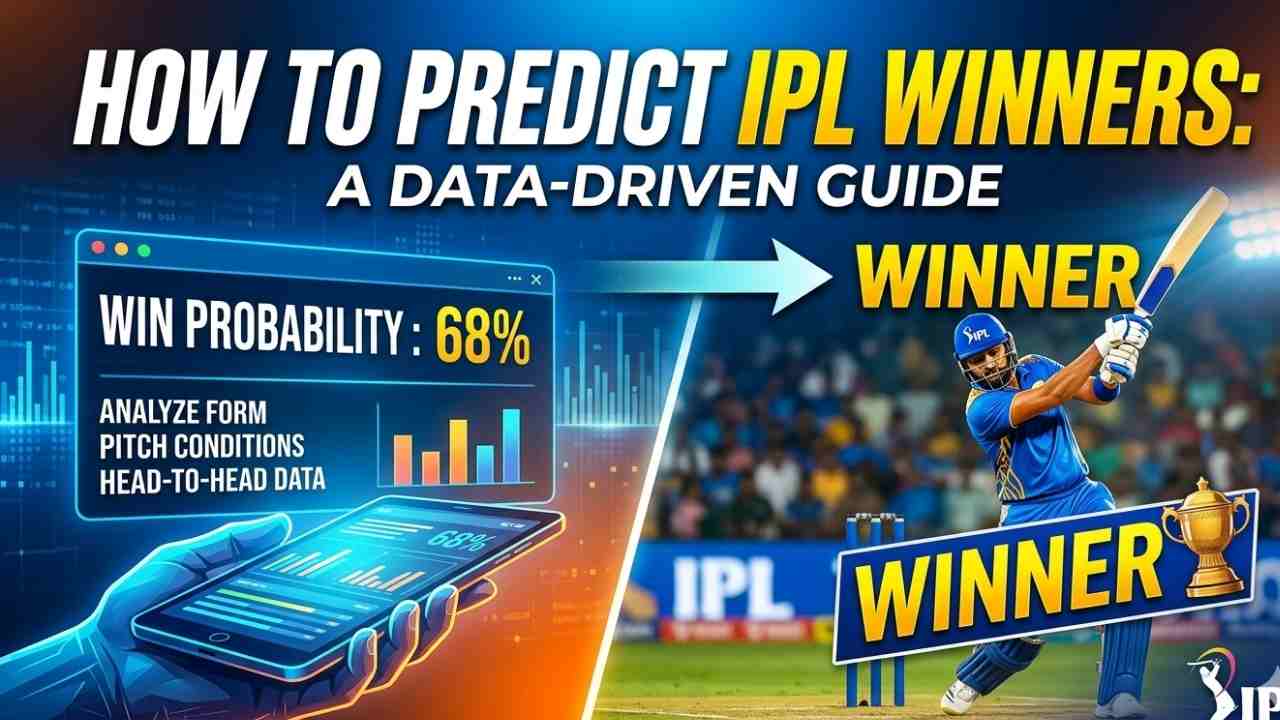
If you are a cricket fan, you already know IPL is not just a tournament, it is pure emotion. One day a team looks unstoppable, next day they collapse like a house of cards. So the big question is simple: How to Predict IPL Match Winners: A Data-Driven Guide in a smart, practical way?
Honestly, there is no magic formula. But yes, if you mix stats, pitch reading, team balance, toss impact, player form, and a little match context, your prediction becomes much better. Dekho, cricket is still unpredictable, but data can reduce guesswork. In this guide, I’ll explain what this topic really means, why it matters, how people use numbers to predict winners, and what impact it has on fans, fantasy players, and even casual viewers.
When I first read about this, honestly thoda confusing laga. Too many stats, too many terms, and everyone claiming they know the “sure winner.” But once you understand the basics, it becomes interesting. You start seeing patterns. You start asking the right questions. And that makes IPL viewing even more fun.
Table of Contents
- What is How to Predict IPL Match Winners: A Data-Driven Guide
- Why data matters in IPL predictions
- Key factors that decide match winners
- How to use stats in a simple way
- Real impact on fans and fantasy users
- Data table and comparison
- Public reaction and social buzz
- FAQ
What is How to Predict IPL Match Winners: A Data-Driven Guide?
How to Predict IPL Match Winners: A Data-Driven Guide means using available cricket data to estimate which team has a better chance of winning an IPL match. It is not about blind guessing. It is about reading numbers, recent performance, venue history, player form, and match conditions in a proper way.
In simple words, it is a method to answer questions like: Which team is stronger on this pitch? Which batsman is in form? Is the bowling attack good enough for death overs? Does the toss matter today? These small things add up.
And yes, this is not only for analysts. Even normal fans, fantasy cricket players, and people who discuss cricket with friends can use this approach. The goal is not to become a “fortune teller.” The goal is to become a smarter cricket watcher.
Why did this trend start?
The reason is very clear. IPL is high-pressure, fast-paced, and packed with data. Every match has huge fan interest, fantasy league involvement, and online betting-style prediction culture in some spaces. People don’t want random opinions anymore. They want logic.
Earlier, fans used to say, “Team X will win because it feels strong.” Now the conversation is more like, “Team X has a better powerplay strike rate, better spin record on this ground, and a more stable middle order.” That shift happened because data became easy to access.
Another reason is social media. After every match, fans compare predictions with actual results. This creates curiosity. Everyone wants to know: can numbers really forecast an IPL result, or is cricket still too unpredictable? That question itself keeps the trend alive.
Key factors in How to Predict IPL Match Winners: A Data-Driven Guide
Let’s get practical. If you want to predict an IPL winner, these are the most useful factors:
- Team form: Last 5 matches matter a lot, especially in a short tournament.
- Head-to-head record: Some teams just match up better against others.
- Venue stats: A ground in Chennai behaves very differently from one in Bengaluru.
- Toss impact: On some pitches, chasing is easier. On others, batting first is safer.
- Player availability: Injuries, rest, or overseas player changes can shift the balance.
- Batting depth: Teams with lower-order hitters often recover better.
- Bowling variety: Good pace + spin combination usually gives more control.
- Pressure handling: Some teams are mentally stronger in close games.
Waise, one important thing people often ignore is match context. A team may look weak on paper but still win if the pitch suits their style. So never judge only by big names.
How exactly does the data work?
Now the main explanation. Data-driven prediction usually starts with collecting match-related numbers from reliable sources. Then you compare patterns. For example, if Team A wins 70% of matches at a specific venue and Team B struggles against spin, the probability tilts a little toward Team A.
This is not about certainty. It is about probability. That is the biggest difference. A data model may tell you Team A has a 62% chance and Team B has 38%. That still means surprises can happen. And IPL is famous for surprises, right?
Some people use simple manual analysis. Others use advanced models with run rates, wickets per over, player strike rates, economy rates, and even weather data. But even basic analysis can be very useful if done honestly.
Real impact on people and users
The real impact is huge. For fantasy cricket users, better predictions can help in choosing captain, vice-captain, and playing XI combinations. For regular fans, it makes watching more exciting because they start noticing patterns instead of only cheering emotionally.
For content creators and analysts, data-driven IPL prediction helps build trust. People like insights that feel grounded. Nobody wants random “100% sure” claims anymore. And honestly, that is a good thing.
But there is also a downside. Some users rely too much on predictions and forget that cricket is still a game of moments. A dropped catch, a sudden injury, or one crazy over can change everything. So the smart approach is: use data, but don’t worship it.
Public reaction and social buzz
IPL prediction content always gets attention online. Before every match, social media fills up with polls, stat graphics, fantasy tips, and “who will win today?” debates. Fans love it because it gives them something to discuss before the first ball is bowled.
At the same time, there is healthy skepticism too. Many fans say predictions are fun but not always reliable. And that reaction is fair. Cricket is emotional, and IPL especially has too many variables. One over can flip the whole story.
Still, the buzz proves one thing: people enjoy understanding the game deeply. They don’t just want highlights. They want logic, numbers, and a reason behind the result. That is why this topic keeps trending every season.
Simple method to predict IPL winners like a pro
If you want a practical method, try this:
- Check last 5 match results of both teams.
- Look at venue history and pitch behavior.
- Compare top-order batting strength.
- Check bowling form, especially powerplay and death overs.
- See whether key players are fit and available.
- Read toss and weather conditions on match day.
- Finally, compare all factors and assign a likely edge.
This approach is simple but effective. You don’t need to be a data scientist. You just need discipline and a little patience.
Data comparison table
| Factor | Why it matters | What to check |
|---|---|---|
| Recent form | Shows momentum and confidence | Last 5 matches, batting collapse, bowling control |
| Venue record | Some teams perform better on specific grounds | Wins, losses, average scores, chasing success |
| Head-to-head | Reveals matchup advantage | Past meetings, close finishes, dominance patterns |
| Player fitness | Missing stars can change balance | Injury updates, replacement players, workload |
| Pitch and weather | Directly affects batting and bowling | Dry pitch, dew, rain chance, spin help |
What exactly happened in the rise of data-driven IPL predictions?
What exactly happened is that cricket moved from pure opinion to informed analysis. Earlier, fans depended on gut feeling. Now they have access to scorecards, heat maps, player stats, and trend reports within seconds. That changed the way people predict matches.
It also made discussions more meaningful. Instead of just saying “my team is better,” people now say why they think so. This has improved fan engagement and made cricket conversations smarter. Of course, some overconfident predictions still happen, but that is part of the fun.
Final honest opinion
My honest opinion? How to Predict IPL Match Winners: A Data-Driven Guide is useful, but only if you stay balanced. Data can guide you, not guarantee you. If you use stats wisely, you will make better predictions and enjoy IPL more. But if you treat every number like final truth, you may get disappointed.
So the best formula is simple: stats + context + common sense. That’s it. Cricket is a game of skill, pressure, and surprise. And that is exactly why we love it.
If you want to explore more cricket insights, check these pages: IPL Match Analysis Guide and Fantasy Cricket Tips for Beginners.
For reliable cricket data and match records, you can also refer to trusted sources like IPL Official Website and ESPNcricinfo.
FAQ
Can data really predict IPL match winners accurately?
Yes, data improves prediction quality, but it cannot give 100% certainty. IPL has many unpredictable moments.
What is the most important factor in IPL prediction?
Recent form, venue record, and player availability are usually the biggest factors. Toss and pitch also matter a lot.
Is fantasy cricket prediction the same as match prediction?
Not exactly. Fantasy prediction focuses on player points, while match prediction focuses on which team is more likely to win.
Do toss and dew really change match results?
Yes, especially in night matches. Dew can make bowling difficult in the second innings and help chasing teams.
Which data source is best for IPL analysis?
Official stats, IPL records, and trusted cricket websites like IPL official and ESPNcricinfo are good starting points.
Disclaimer: The above information is based on public sources and latest updates. Please verify official details.